Process Control Block During a File Upload
Learn well-nigh Procedure Control Cake (PCB) in OS.
Overview
The process control cake represents a process in the operating system. A process control cake is too known every bit a job control block. Information technology's a repository of information associated with a specific process.
Scope
- We will learn almost Process control block(PCB), its construction, part of PCB in operating systems.
- We will discuss each attribute of the process control block in detail.
- We will besides learn nearly procedure tables and how PCBs are stored in memory.
- This article does not cover any process scheduling algorithm and code implementation.
Introduction
We come up across many processes running at the same time in our operating organization. Every process has some data and execution instructions accompanied. These instructions can exist a lawmaking execution or list of devices(like a printer) that will be used to interact, during the execution of a process. So, there arises a need for a data structure that tin can store every information of a process, known as process control block (PCB) .
Definition
When the procedure is created by the operating system information technology creates a data structure to shop the information of that process. This is known every bit Process Control Cake (PCB) .
Process Control block (PCB) is a information structure that stores information of a process.
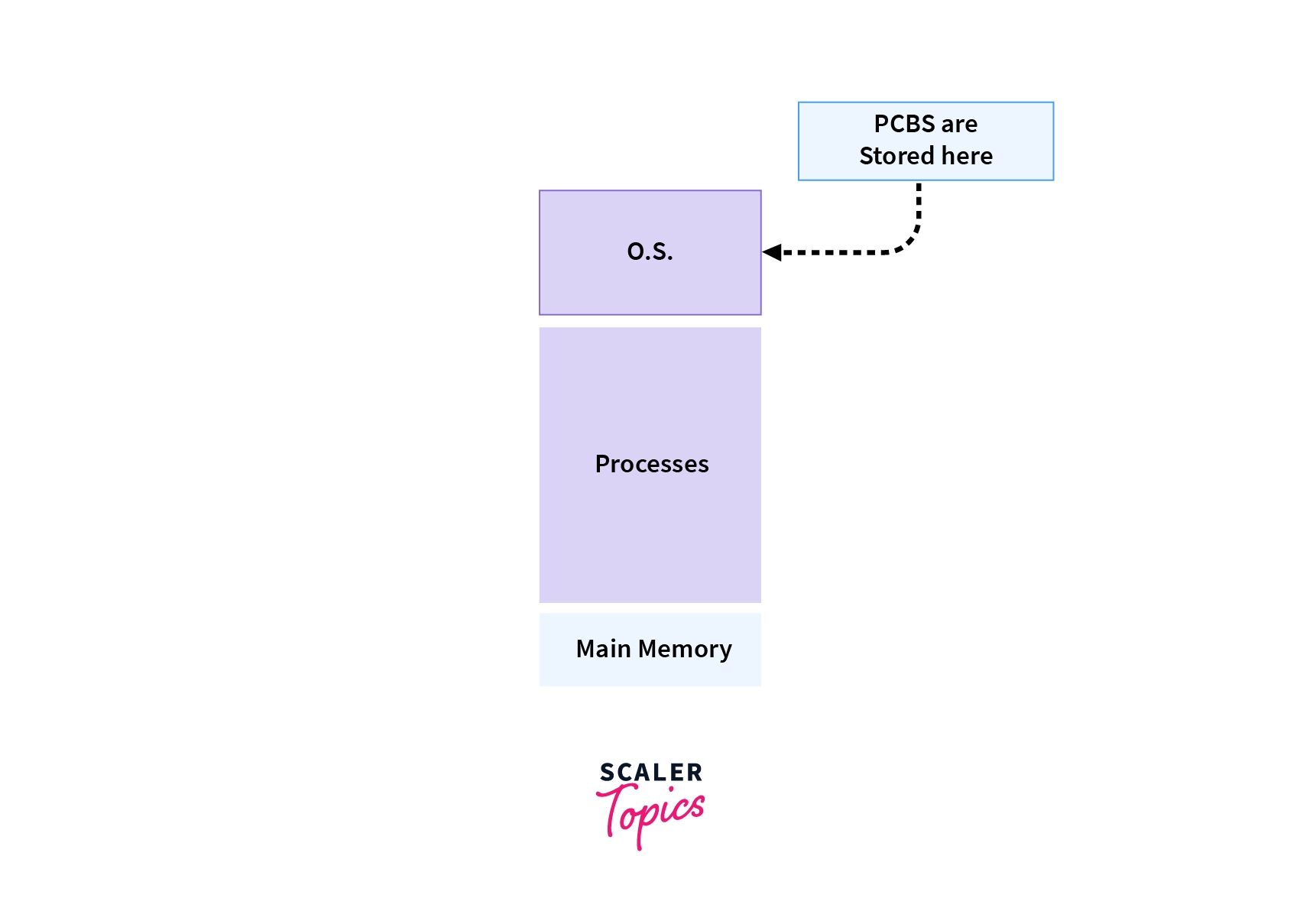
PCBs are stored in specially reserved memory for the operating organization known as kernel infinite.
Annotation: The Random Access Memory (RAM) tin be logically divided into two singled-out regions namely - the kernel space and the user space. Kernel space is the core of the operating arrangement. It ordinarily has full access to all memory and auto hardware and it cant be accessed past the user.
PCB is unique for every procedure which consists of diverse attributes such as process ID, priority, registers, plan counters, process states, list of open up files, etc.
Part of Procedure Control Block
It'south the job of the operating organisation to assign a CPU to a process every bit the process doesn't demand a CPU all the time. Let's accept an example of the input/output process, they are only used by the CPU when triggered.
The role of process command block arises equally an identification card of each procedure. The Operating Arrangement doesn't know which procedure is which, until Operating Arrangement refers through the PCB of every process. For example, at that place are MS discussion procedure, pdf process, press process, and many background processes are running currently on the CPU. How volition OS identify and manage each process without knowing the identity of each process?
So, here PCB comes into play as a data structure to store data of each procedure.
Therefore, whenever a user triggers a process (like print command), a process control block (PCB) is created for that process in the operating organization which is used by the operating arrangement to execute and manage the processes when the operating system is free.
Construction of Process Command Cake
The process control block contains many attributes such as process ID, process state, process priority, accounting information, program counter, CPU registers`, etc for each process.

Now we volition hash out each field of PCB in detail.
ane. Procedure ID:
When a new process is created by the user, the operating system assigns a unique ID i.e a process-ID to that process. This ID helps the process to exist distinguished from other processes existing in the system.
The operating system has a limit on the maximum number of processes it is capable of dealing with, let'due south say Bone can handle atmost N processes at a time.
So, process-ID volition go the values from 0 to N-1.
-
Outset process volition be given ID0.
-
Second process will be given ID 1.
-
It continues till N-i.
At present if a new process is created after process(Northward-1) so Operating Organisation will destine ID 0 to this new process because the older process at id 0 is already terminated. This is one of the schemes for assigning the process ids.
There is another scheme of assignment where the process IDs are not allocated in ascending gild.
Let's say a single PCB requires X bytes of retention and in full there can be North processes allowed at a time. Then, the operating organisation will reserve N*X bytes for all the PCBs.
These PCBs are numbered from 0 to N-1. Delight note here we are giving IDs to PCBs and not to the processes.
At present whenever a procedure is triggered by the user a free PCB slot is allotted to that procedure and the process ID of that process will exist the same as the PCB slot number. And then, the operating arrangement maintains a chain of gratuitous PCB slots. If the concatenation is empty no new procedure can exist created.
2. Process Land:
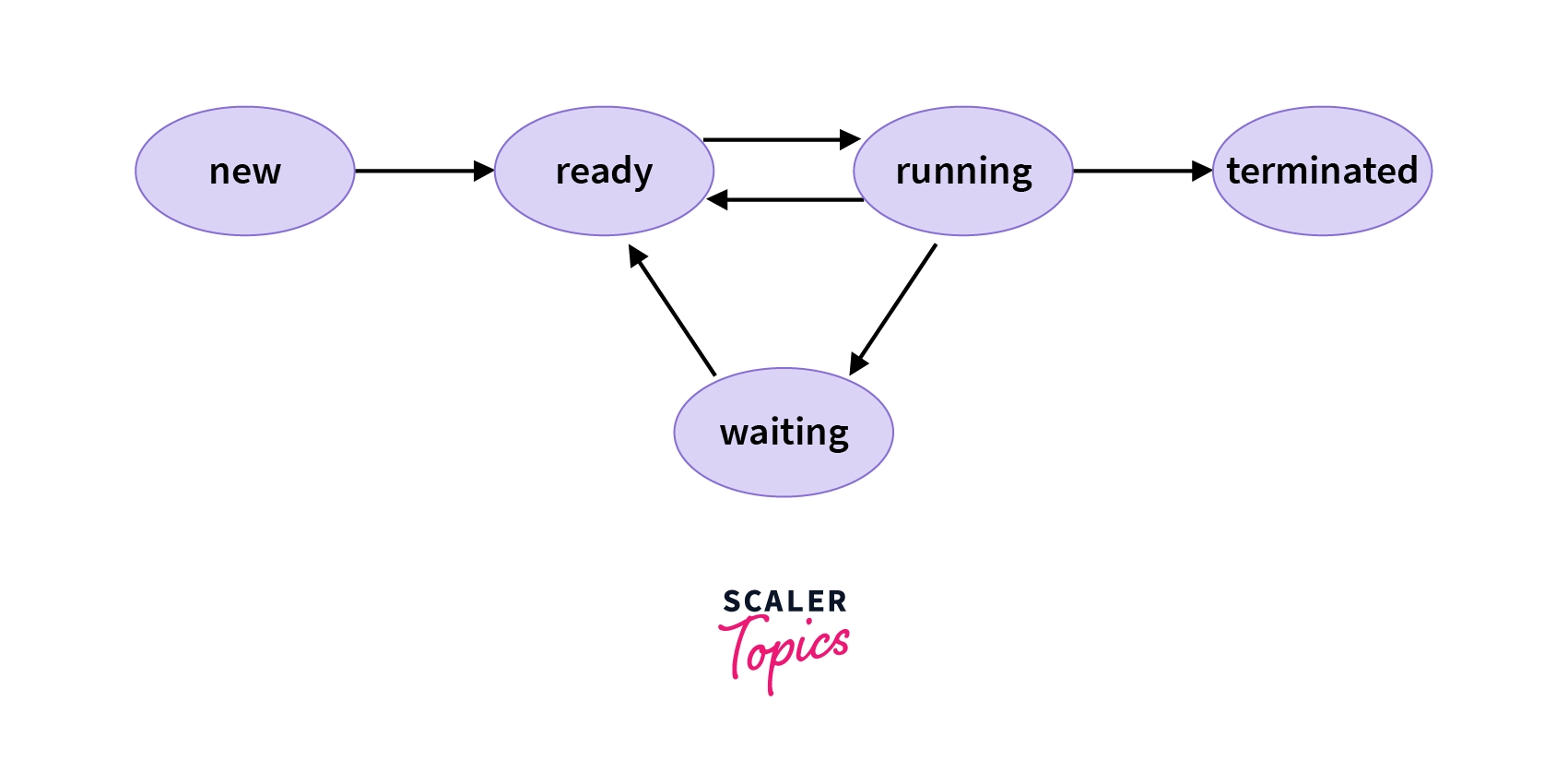
A process, from its cosmos to completion goes through different states. By and large, a process may be present in i of the five states during its execution:
-
New: This state contains the processes which are fix to be loaded by the operating system into the main retention.
-
Ready: This state contains the process which is both ready to be executed and is currently in the main memory of the organisation. The operating system brings the processes from secondary memory(hd) to main retentiveness(RAM). Equally these processes are present in the main retentivity and are waiting to exist assigned to the CPU, the land of these processes is known equally Set up state.
-
Running: This country contains the processes which are currently executed by the CPU in our system. If there is a total x CPU in our system, then a maximum number of running processes for a item fourth dimension is also ten.
-
Cake or wait: A process from its running state may transition to a cake or expect for state depending on the scheduling algorithm or considering of the internal behavior of the process (process explicitly wants to wait).
-
Termination: A process that completes its execution comes to its termination state. All the contents of that process(Procedure command block) will also be deleted by the operating organization.
3. Procedure Priority:
Process priority is a numeric value that represents the priority of each process. The bottom the value, the greater the priority of that process. This priority is assigned at the time of the creation of the PCB and may depend on many factors like the historic period of that procedure, the resource consumed, and and then on. The user can too externally assign a priority to the process.
4. Process Accounting Data:
This attribute gives the information of the resources used by that process in its lifetime. For example, CPU time connection time, etc.
v. Program Counter:
The program counter is a pointer that points to the next teaching in the program to be executed. This aspect of PCB contains the address of the side by side education to be executed in the process.
vi. CPU registers:
A CPU register is a quickly accessible pocket-sized-sized location available to the CPU. These registers are stored in virtual memory(RAM).
*Context Switching '*: A context switching` is a process that involves switching the CPU from 1 process or task to another. Information technology is the process of storing the state of a process and so that it can be restored and resume execution at a later bespeak. This allows multiple processes to share a single CPU and is an essential characteristic of a multitasking operating system.
So, whenever context switching occurs in the lawmaking execution then the current state of that procedure is stored temporarily in CPU registers. This helps in the fast execution of the procedure by not wasting time-saving and retrieving state information from the secondary memory(hard disk).
7. PCB arrow:
This field contains the address of the next PCB, which is in ready state. This helps the operating organisation to hierarchically maintain an easy control flow between parent processes and child processes.
eight. List of open up files:
As the proper name suggests, It contains information on all the files that are used by that procedure. This field is important every bit it helps the operating system to close all the opened files at the termination state of the process.
9. Process I/O information:
In this field, the listing of all the input/output devices which are required by that process during its execution is mentioned.
How PCBs are Stored?
PCBs are stored in the form of LinkedList in memory as shown in the figure.
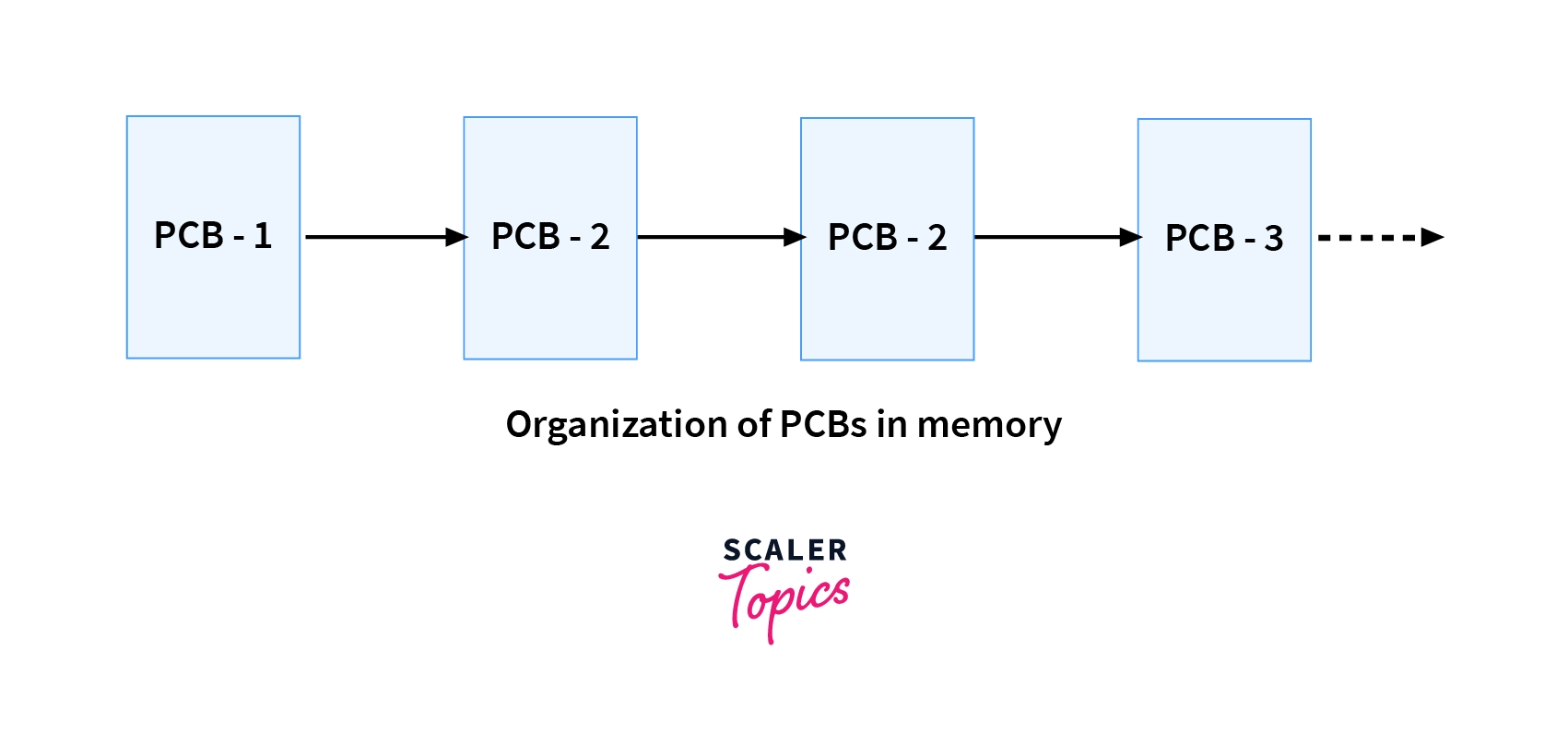
Operating System uses Procedure Table to find the PCB nowadays in retentivity.
Procedure tabular array is a tabular array that contains Procedure ID and the reference to the corresponding PCB in retention. Nosotros tin visualize the Process table every bit a dictionary containing the list of all the processes running.
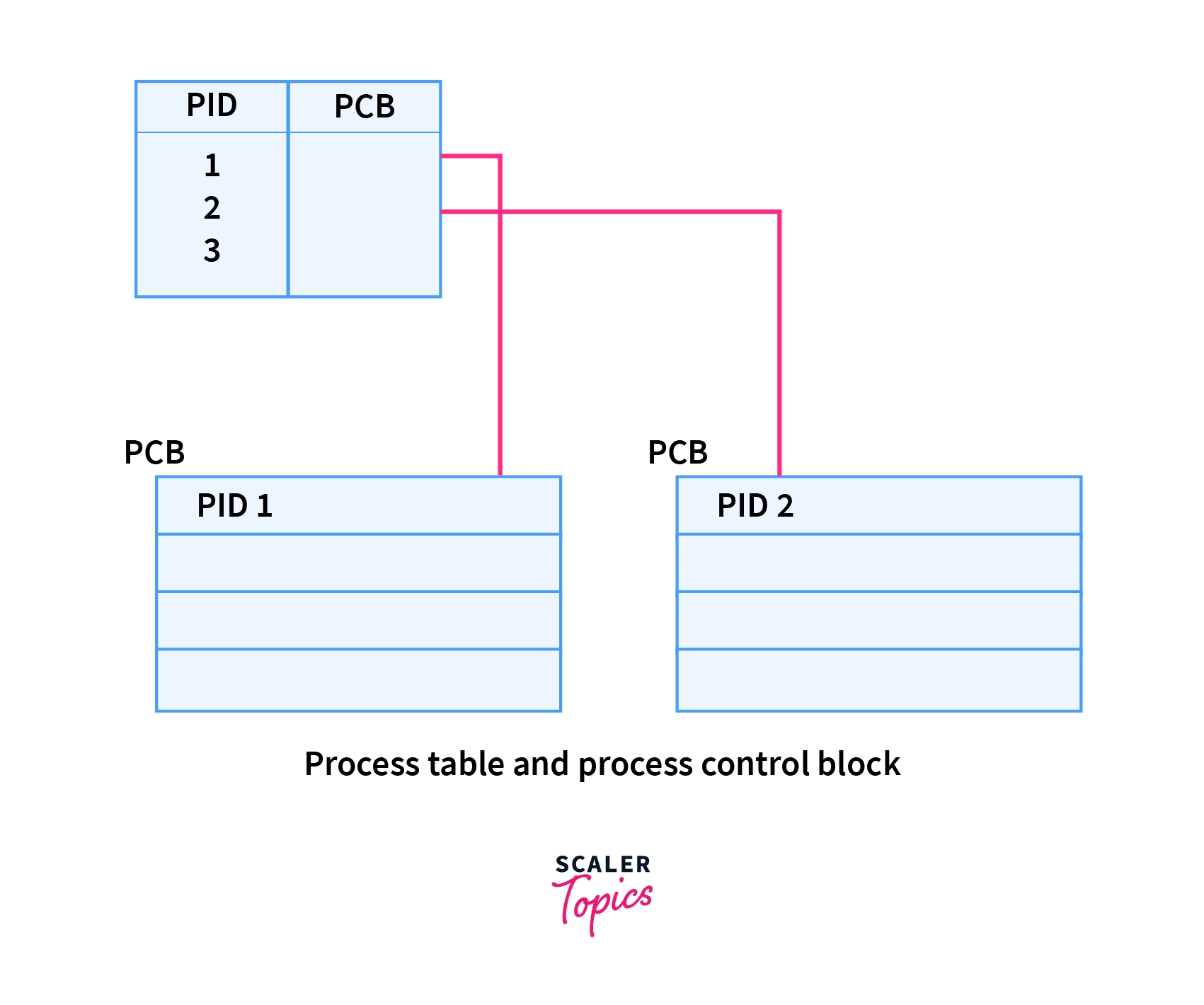
So, whenever a context switch occurs between processes the operating system refers to the Process table to discover the reference to the PCB with the help of the corresponding Process ID.
Summary
- Process Control Block (PCB) is a information construction maintained by the operating arrangement to store information of each process.
- Role of PCB is to requite identity to each procedure then that Operating Organisation tin can hands distinguish between processes.
- PCB contains fields like procedure ID, process priority, process land, bookkeeping information, listing of open up files, etc.
- PCBs are stored in the class of LinkedList in the memory.
- Process tabular array contains a reference to every process currently being executed in the system. So, whenever OS performs context switching it refers to the process table for the required process.
Source: https://www.scaler.com/topics/operating-system/process-control-block-in-os/
0 Response to "Process Control Block During a File Upload"
Post a Comment